Novo guideline americano para o tratamento de pneumonia hospitalar e VAP

image

Clique aqui

(dica do link do nosso R3 Rodrigo)

Para ser lido e refletido. Considere que há diferenças importantes da realidade americana (e por osmose dos grandes serviços de São Paulo) e a realidade da maior parte do Brasil.  Nós usamos Poli B e não temos acesso à colistina, não temos acesso à dosagem de nível sérico de antimicrobianos, e mesmo uma cultura semi-quantitativa pode não está disponível na maioria dos serviços.


Effect of Chlorhexidine Bathing Every Other Day on Prevention of Hospital-Acquired Infections in the Surgical ICU: A Single-Center, Randomized Controlled Trial | Read by QxMD

OBJECTIVE: To test the hypothesis that compared with daily soap and water bathing, 2% chlorhexidine gluconate bathing every other day for up to 28 days decreases the risk of hospital-acquired catheter-associated urinary tract infection, ventilator-associated pneumonia, incisional surgical site infection, and primary bloodstream infection in surgical ICU patients. DESIGN: This was a single-center, pragmatic, randomized trial. Patients and clinicians were aware of treatment-group assignment; investigators who determined outcomes were blinded. SETTING: Twenty-four-bed surgical ICU at a quaternary academic medical center. PATIENTS: Adults admitted to the surgical ICU from July 2012 to May 2013 with an anticipated surgical ICU stay for 48 hours or more were included. INTERVENTIONS: Patients were randomized to bathing with 2% chlorhexidine every other day alternating with soap and water every other day (treatment arm) or to bathing with soap and water daily (control arm). MEASUREMENTS AND MAIN RESULTS: The primary endpoint was a composite outcome of catheter-associated urinary tract infection, ventilator-associated pneumonia, incisional surgical site infection, and primary bloodstream infection. Of 350 patients randomized, 24 were excluded due to prior enrollment in this trial and one withdrew consent. Therefore, 325 were analyzed (164 soap and water versus 161 chlorhexidine). Patients acquired 53 infections. Compared with soap and water bathing, chlorhexidine bathing every other day decreased the risk of acquiring infections (hazard ratio = 0.555; 95% CI, 0.309-0.997; p = 0.049). For patients bathed with soap and water versus chlorhexidine, counts of incident hospital-acquired infections were 14 versus 7 for catheter-associated urinary tract infection, 13 versus 8 for ventilator-associated pneumonia, 6 versus 3 for incisional surgical site infections, and 2 versus 0 for primary bloodstream infection; the effect was consistent across all infections. The absolute risk reduction for acquiring a hospital-acquired infection was 9.0% (95% CI, 1.5-16.4%; p = 0.019). Incidences of adverse skin occurrences were similar (18.9% soap and water vs 18.6% chlorhexidine; p = 0.95). CONCLUSIONS: Compared with soap and water, chlorhexidine bathing every other day decreased the risk of acquiring infections by 44.5% in surgical ICU patients.

Fonte: Effect of Chlorhexidine Bathing Every Other Day on Prevention of Hospital-Acquired Infections in the Surgical ICU: A Single-Center, Randomized Controlled Trial | Read by QxMD

Catheter-Associated UTI Prevention — NEJM

Quick Take Video Summary from The New England Journal of Medicine — Catheter-Associated UTI Prevention

Fonte: Catheter-Associated UTI Prevention — NEJM

Vídeo bacana do NEJM sobre prevenção de ITU em cateterização vesical. Infelizmente em inglês.

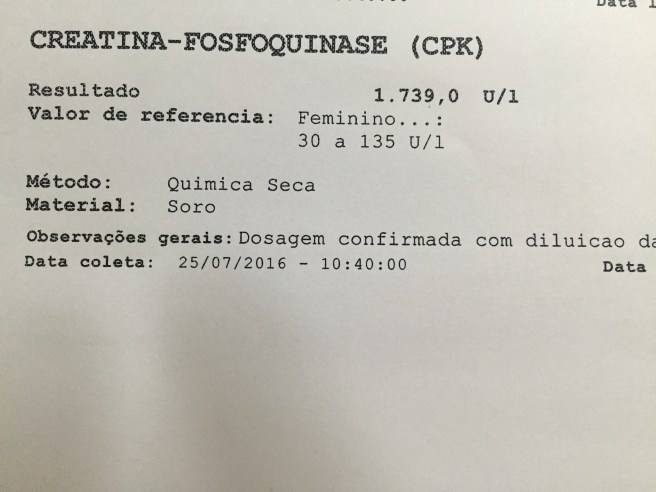
Miopatia por daptomicina

imageimage

Paciente com infecção de sítio cirúrgico por VRE. Com 10 dias de daptomicina começou a se queixar de dor muscular, que só piorou com o progredir do tratamento. Vejam o valor da CPK. A ALT e AST também se elevaram. Neste caso em particular não houve alteração da função renal.

Stopping Antibiotic Overprescribing: What Works?

The problem of antibiotic overprescribing has multifactorial causes, but lack of education isn’t one of them.

Fonte: Stopping Antibiotic Overprescribing: What Works?

Not a Knowledge Problem

Bacteria Can Persist on Gloves, Transfer to Surfaces

image

Acesse a reportagem do Medscape aqui

A bactéria em questão é o Acinetobacter balmani, figurinha carimbada dos serviços de controle de infecção hospitalar.

Fluoroquinolones: Not First-Line Treatment

image92

Dr Paul Auwaerter comments on the FDA advisory with new warnings about the use of fluoroquinolones.

Fonte: Fluoroquinolones: Not First-Line Treatment

Esta é uma tendência bastante atual nos EUA com a qual eu simpatizo. Oxalá a moda pegue aqui também.

‘Superbácterias matarão uma pessoa a cada 3 segundos em 2050’ – Notícias – Saúde

Fonte: ‘Superbácterias matarão uma pessoa a cada 3 segundos em 2050’ – Notícias – Saúde

Será? Tenho sempre restrições quanto à esses exercícios de futurologia, mas a preocupação é válida…já a partir dos dias atuais.

Vídeo: Como bactérias multiR se transmitem em hospitais

cropped-bacterias.jpgacesse via facebook

Fácil de entender como bactérias multirresistentes se disseminam em hospitais. Mais uma dica do meu amigo Dr. Arnaldo Gouveia Jr de Americana.

New Therapeutic Options for Skin and Soft Tissue Infections

image

Read about the new approved drugs for the treatment of MRSA complicated skin and soft tissue infections.

Fonte: New Therapeutic Options for Skin and Soft Tissue Infections

Embora focado em infecções de pele e partes moles, traz uma bela revisão das mais atuais opções para o tratamento de infecções por MRSA.