27513890 (PDF do artigo)
Se as DSTs já são negligenciadas no seu conjunto, o que não dizer do linfogranuloma venéreo, o patinho feio da turma!!

27513890 (PDF do artigo)
Se as DSTs já são negligenciadas no seu conjunto, o que não dizer do linfogranuloma venéreo, o patinho feio da turma!!
Apesar da intensificação das ações de vigilância e controle, os casos de sífilis, e consequentemente os casos de transmissão congênita, tem desafiado os médicos e autoridades sanitárias.

Definitivamente a nova definição de sepsis, publicada recentemente no JAMA não foi uma unanimidade. Este editorial do Medscape explora esta polêmica.

OBJECTIVE: To test the hypothesis that compared with daily soap and water bathing, 2% chlorhexidine gluconate bathing every other day for up to 28 days decreases the risk of hospital-acquired catheter-associated urinary tract infection, ventilator-associated pneumonia, incisional surgical site infection, and primary bloodstream infection in surgical ICU patients. DESIGN: This was a single-center, pragmatic, randomized trial. Patients and clinicians were aware of treatment-group assignment; investigators who determined outcomes were blinded. SETTING: Twenty-four-bed surgical ICU at a quaternary academic medical center. PATIENTS: Adults admitted to the surgical ICU from July 2012 to May 2013 with an anticipated surgical ICU stay for 48 hours or more were included. INTERVENTIONS: Patients were randomized to bathing with 2% chlorhexidine every other day alternating with soap and water every other day (treatment arm) or to bathing with soap and water daily (control arm). MEASUREMENTS AND MAIN RESULTS: The primary endpoint was a composite outcome of catheter-associated urinary tract infection, ventilator-associated pneumonia, incisional surgical site infection, and primary bloodstream infection. Of 350 patients randomized, 24 were excluded due to prior enrollment in this trial and one withdrew consent. Therefore, 325 were analyzed (164 soap and water versus 161 chlorhexidine). Patients acquired 53 infections. Compared with soap and water bathing, chlorhexidine bathing every other day decreased the risk of acquiring infections (hazard ratio = 0.555; 95% CI, 0.309-0.997; p = 0.049). For patients bathed with soap and water versus chlorhexidine, counts of incident hospital-acquired infections were 14 versus 7 for catheter-associated urinary tract infection, 13 versus 8 for ventilator-associated pneumonia, 6 versus 3 for incisional surgical site infections, and 2 versus 0 for primary bloodstream infection; the effect was consistent across all infections. The absolute risk reduction for acquiring a hospital-acquired infection was 9.0% (95% CI, 1.5-16.4%; p = 0.019). Incidences of adverse skin occurrences were similar (18.9% soap and water vs 18.6% chlorhexidine; p = 0.95). CONCLUSIONS: Compared with soap and water, chlorhexidine bathing every other day decreased the risk of acquiring infections by 44.5% in surgical ICU patients.
Infelizmente sem link para o artigo.

During a 2014 outbreak, 450 patients with confirmed chikungunya virus infection were admitted to the University Hospital of Pointe-à-Pitre, Guadeloupe. Of these, 110 were nonpregnant adults; 42 had severe disease, and of those, 25 had severe sepsis or septic shock and 12 died. Severe sepsis may be a rare complication of chikungunya virus infection.
Preocupante, muito preocupante…

Cardiovascular disease is becoming the leading cause of morbidity and mortality for patients infected with HIV. Learn what you need to know to care for patients.
Fonte: CV Care for the Patient With HIV: What You Need to Know

BACKGROUND: âThe 2014-2015 influenza season was severe, with widespread circulation of influenza A (H3N2) viruses that were antigenically drifted from the vaccine virus. Reported vaccine effectiveness (VE) estimates from ambulatory care settings were markedly decreased. METHODS: âAdults, hospitalized at two hospitals in southeast Michigan for acute respiratory illnesses, defined by admission diagnoses, of â¤10 days duration were prospectively enrolled. Throat and nasal swab specimens were collected, combined, and tested for influenza by RT-PCR. VE was estimated by comparing the vaccination status of those who tested positive for influenza with those who tested negative in logistic regression models adjusted for age, sex, hospital, calendar time, time from illness onset to specimen collection, frailty score, and Charlson Comorbidity Index (CCI). RESULTS: âAmong 624 patients included in the analysis, 421 (68%) were considered vaccinated, 337 (54%) were female, 220 (35%) were age â¥65 years, and 92% had CCI >0 indicating â¥1 comorbid conditions. 98 (16%) patients tested positive for influenza A (H3N2); among 60 (61%) A (H3N2) viruses tested by pyrosequencing, 53 (88%) belonged to the drifted 3C.2a genetic group. Adjusted VE was 43% (95% CI: 4 to 67) against influenza A (H3N2); 40% (95% CI: -13 to 68) for those <65 years of age and 48% (95% CI: -33 to 80) for those â¥65. Sensitivity analyses largely supported these estimates. CONCLUSIONS: âVE estimates appeared higher than reports from similar studies in ambulatory care settings, suggesting that the 2014-15 vaccine may have been more effective in preventing severe illness requiring hospitalization.
Taxas de eficácia abaixo de 50% e ainda assim resultados muito melhores do que em anos anteriores. Definitivamente precisamos de vacinas com capacidade de proteção em patamares superiores a estes.
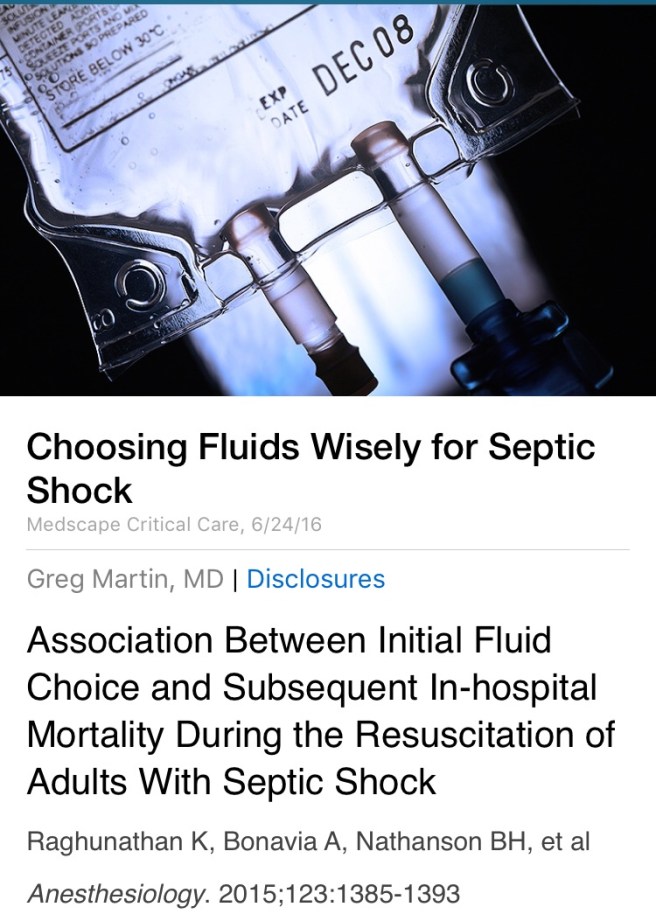
É o primeiro trabalho que leio em que soluções balanceadas de cristalóides tem resultado superior ao SF na ressucitação da Sepsis. Será assim mesmo?
 Acesse o Medscape aqui
 blog infectologia em geral